
Prof. Javeed Ahmad Mugloo
SRINAGAR, J&K — The rural economy of the Kashmir Valley stands at a critical crossroads.
For generations, traditional agriculture has been the undisputed backbone of the region. Today,
however, a combination of shrinking landholdings, unpredictable climate shifts, and declining
farm incomes is putting unprecedented pressure on rural livelihoods.
To survive and thrive, the agricultural sector needs a paradigm shift. Experts, researchers, and
policymakers are increasingly pointing to a highly effective, nature-based solution:
agroforestry.
By deliberately integrating crops and livestock with tree species and significantly increasing
Tree Cover Outside Forests (ToF) agroforestry offers a resilient pathway to safeguard the
fragile Himalayan ecosystem while directly boosting farmers’ incomes.
The traditional reliance on monoculture leaves farmers highly vulnerable to market fluctuations
and total crop failures. Agroforestry fundamentally changes this dynamic. By combining
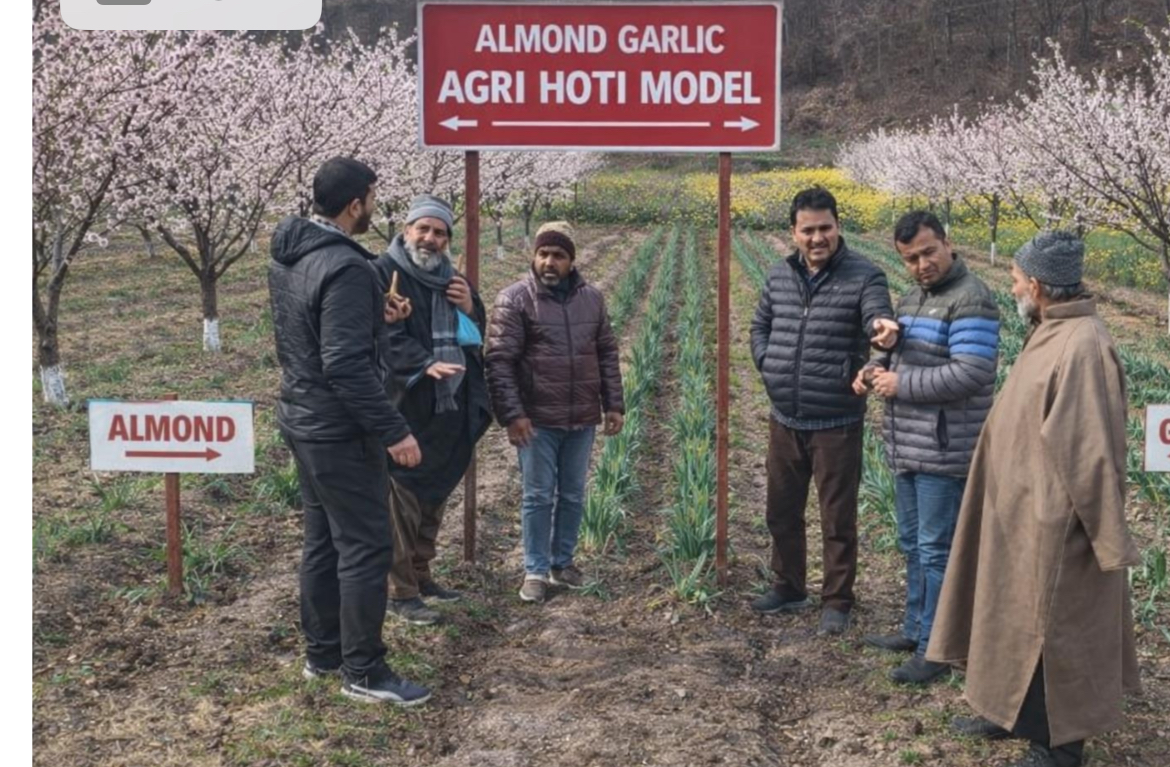
agricultural crops with fast-growing or fruit-bearing trees like poplar, willow, robinia, and
apple, farmers can build a vital economic safety net.
Prof. Javeed Ahmad Mugloo, emphasizes that this integration is no longer optional but essential
for modern farming in the region.”When farmers move away from single-crop dependency, they unlock multiple revenue streams
from the exact same piece of land—harvesting timber, fruits, fodder, and staple crops
simultaneously.”
Recent research has demonstrated that integrated land use can achieve a remarkable Benefit-
Cost (B:C) ratio, significantly outperforming the conventional monoculture.
Beyond the balance sheet, agroforestry acts as a vital ecological buffer. The Himalayan region
is highly sensitive to climate variability, and integrated farming systems make landscapes
inherently more resilient.
Trees integrated into farmlands naturally improve soil fertility, prevent catastrophic topsoil
erosion during heavy rains, and enhance local biodiversity. Most importantly, these systems
serve as powerful carbon sinks. By sequestering atmospheric carbon, agroforestry allows the
agricultural sector to actively participate in climate change mitigation while ensuring long-term
ecological balance.
Despite the clear advantages of systems like agri-silviculture and horti-silviculture, widespread
adoption across the Kashmir Valley remains frustratingly slow. Farmers face substantial
hurdles, including a lack of technical awareness, poor access to quality planting materials, and
missing market linkages for non-timber forest products.
To transform rural development, institutional support must catch up to the science through a
targeted, multi-pronged approach. This transition begins with scientific capacity building—
equipping farmers with practical training on maximizing land-use efficiency and managing
multi-tier canopies. However, this education must be coupled with reliable resource
accessibility to ensure the steady availability of high-quality, disease-resistant saplings and
seeds. Furthermore, unlocking the true economic potential of these integrated systems requires
the creation of robust, transparent supply chains so farmers can easily monetize their diverse
farm outputs. Finally, to confidently encourage farmers to make this vital shift, policymakers
must develop strong financial safety nets and incentives to support them during the initial
transition period.
Agroforestry is not merely an alternative farming technique; it is a holistic approach to rural
empowerment. By seamlessly blending ecological preservation with economic viability, it
provides a practical, scalable solution to the valley’s most pressing agrarian challenges. With
focused policy interventions and strong community participation, agroforestry can secure a
prosperous, climate-resilient future for rural Kashmir.
Prof. Javeed Ahmad Mugloo is Head, KVK/ETC Pulwama.